My research

I work on bacterial gene expression: how RNA polymerase, which copies DNA into RNA, and the ribosome, which turns that RNA into protein, work together when they run on the same strand at the same time. My BBSRC fellowship looks at ribosome inhibition by tRNA interference. The papers are below, newest first, each with what it found in plain words.

2025 ACS Infectious Diseases First author · with the Errington lab
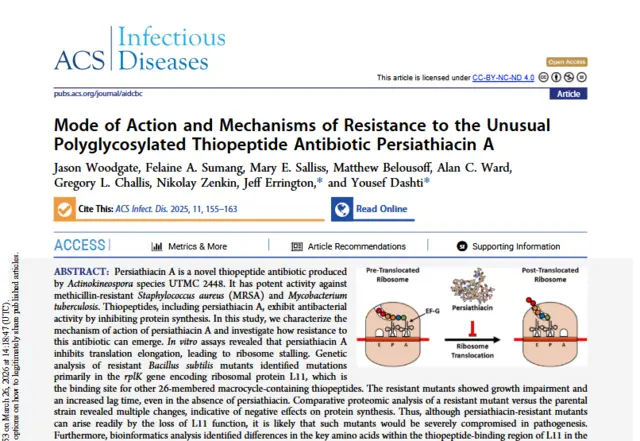
The first page of the paper in ACS Infectious Diseases

Mode of action and mechanisms of resistance to the unusual polyglycosylated thiopeptide antibiotic persiathiacin A

Woodgate, J., Sumang, F.A., Salliss, M.E., Belousoff, M., Ward, A.C., Challis, G.L., Zenkin, N., Errington, J. & Dashti, Y.

Persiathiacin A is a new natural antibiotic, active against MRSA and Mycobacterium tuberculosis. We showed it stops protein synthesis by jamming the ribosome so it cannot move along the mRNA.

Bacteria can become resistant, mostly by losing or changing a ribosomal protein called L11, but the resistant strains grow badly, which suggests they would struggle to cause disease. We also found why the bacterium that makes the antibiotic is not poisoned by it.

Read the paper → ACS Infect. Dis. 11(1), 155-163 (2025)
2024 Nature First author
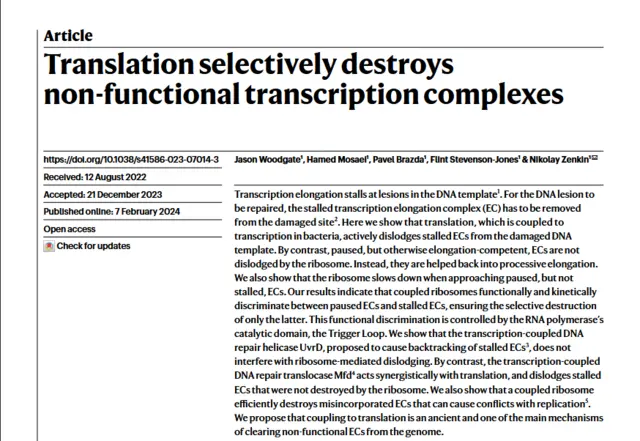
The first page of the paper in Nature

Translation selectively destroys non-functional transcription complexes

Woodgate, J., Mosaei, H., Brazda, P., Stevenson-Jones, F. & Zenkin, N.

When RNA polymerase hits damage in the DNA, it stalls, and a stuck polymerase is a hazard: if the DNA replication machinery runs into it, the DNA can break. Cells have more than one way of handling this. We showed that the ribosome, which in bacteria follows right behind the polymerase, is one of them: it knocks stalled complexes off the DNA.

Polymerases that have only paused get a push back into action instead, and the ribosome slows down as it approaches them. It can tell the two apart, and it also clears polymerases that have built the RNA wrongly. We suggest this is an ancient mechanism for keeping stuck polymerases out of the way of DNA replication.

Read the paper → Nature 626, 891-896 (2024)
2023 Molecular Microbiology First author · Review
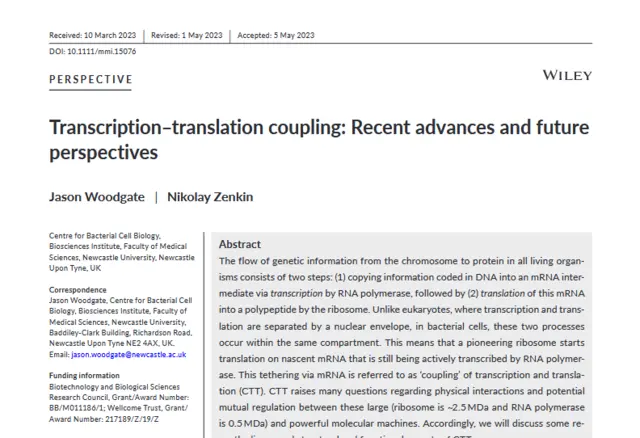
The first page of the paper in Molecular Microbiology

Transcription-translation coupling: recent advances and future perspectives

Woodgate, J. & Zenkin, N.

Bacteria have no nucleus, so the ribosome starts making protein from an RNA that RNA polymerase is still writing. Two very large machines (the ribosome is about 2.5 MDa, RNA polymerase about 0.5 MDa) tied together by one strand of RNA raise a lot of questions about how they touch and steer each other.

This review covers what recent structural and functional work has found, and what is still open.

Read the paper → Mol. Microbiol. 120(4), 539-546 (2023)
2020 PNAS Co-author
The first page of the paper in PNAS

Ribosome reactivates transcription by physically pushing RNA polymerase out of transcription arrest

Stevenson-Jones, F., Woodgate, J., Castro-Roa, D. & Zenkin, N.

RNA polymerase sometimes slides backwards along the DNA and gets stuck, which is called backtracking. It happens for several reasons, the DNA and RNA it is working on among them, and a stuck polymerase gets in the way of DNA replication and can lead to breaks in the DNA.

We showed that the ribosome following behind is not stopped by a backtracked polymerase: it pushes it forwards and out of trouble, and transcription carries on. The two machines also sit closer together than people thought, though without locking into a fixed complex.

Read the paper → Proc. Natl. Acad. Sci. 117(15), 8462-8467 (2020)